Spotlight Series September 2026: Sue Fordham - Creation in Her Hands: A Potter's Story
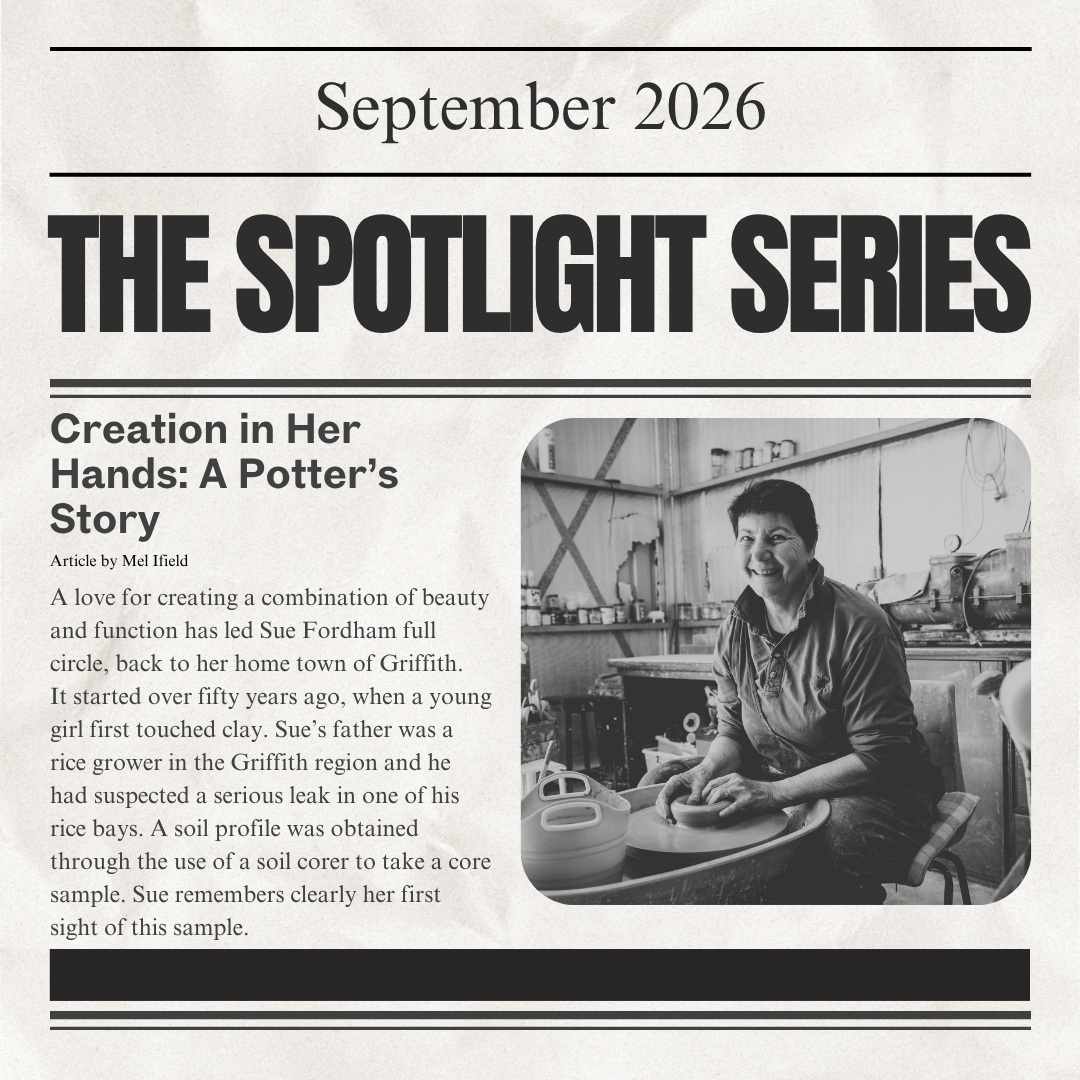
A love for creating a combination of beauty and function has led Sue Fordham full circle, back to her home town of Griffith.
It started over fifty years ago, when a young girl first touched clay. Sue’s father was a rice grower in the Griffith region and he had suspected a serious leak in one of his rice bays. A soil profile was obtained through the use of a soil corer to take a core sample. Sue remembers clearly her first sight of this sample.
“He just came up with this tube of clay. It was so white and had great texture while not falling apart in my hands. He said I could play with it, which I did but I had no real idea of what to do with it. I could roll snakes and sausages with it.” There a future potter got her first introduction to clay. It wasn’t until a wheel pottery demonstration at the Griffith Showgrounds that the passion really took hold. “I was fascinated.”
Sue did her final two years of high school in Canberra and she managed to find a way to start her true artistic endeavours. “Every second Friday we were timetabled an activities afternoon and I chose to do pottery. Actually, I've still got my first pinch pot and mug from that time because as first creations, you treasure them and don't really use them that much and so they survived all these years.”
This cemented her love of the medium, which now has extended to making her own glazes from freely shared recipes online (see https://glazy.org/) and sharing her passion with others.
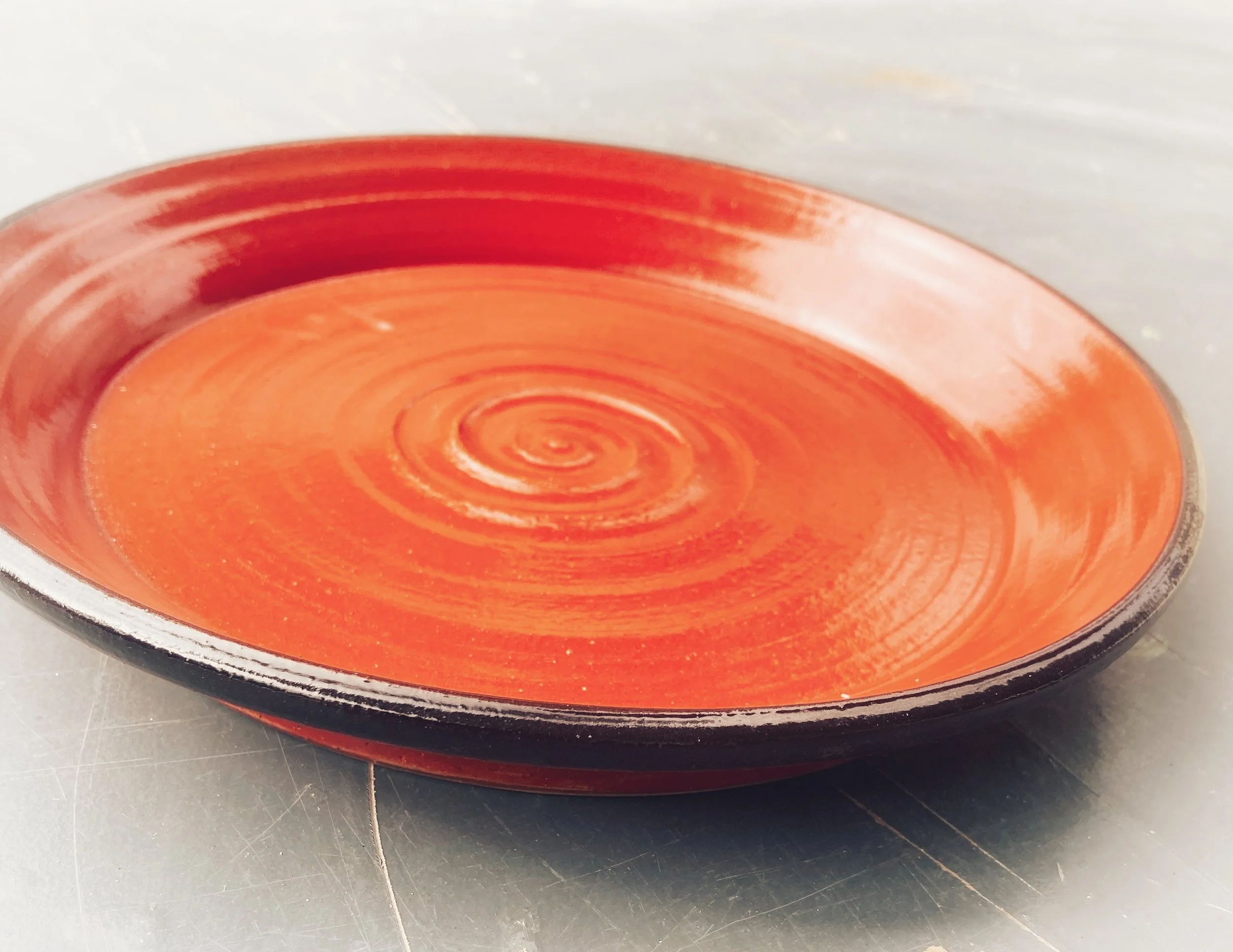
Photo credit: Mel Ifeild Courtesy Western Riverina Arts 2026
Wendy Hart from In the Frame, a shopfront known well in the Riverina district selling art supplies as well as an outlet for Sue’s pottery, said, “People love buying her pottery, as it is a uniquely functional but beautiful way to have art involved in your life. They feel nice – a weight in your hand and we sell quite a few mugs and plates as well. They are unique and different.”
When it came to talking about Sue’s impact in the community for those interested in pottery, Wendy added: “I did a workshop with Sue. She is generous with her knowledge when she is teaching.”
Sue’s childhood dream has fuelled a lifelong passion for working with her hands and clay. She now works out of a long tin shed in the backyard. There, four pottery wheels and three kilns, a drying room and storage for home-made glazes, glaze ingredients, and slabs of raw clay have turned a passion into a home business.
After school she trained as a primary school teacher. “Once again, I didn't do any art subjects per se. I lived in a share house for a period of time with a friend who had a kick wheel that we shared. My first teaching appointment was in the Hunter Valley. I finally had some money so I bought my first kiln and pottery wheel and attended TAFE at night.
Later when Sue’s children were in preschool, she understood that pottery and little kids weren’t a natural fit. “It's very breakable and it's also a process. You've got to do stage one, which is making it, then let it dry to leather hard. Stage two, trim it. Stage three, fire it. Stage four, glaze it. There’re all these stages you have to go through and you can't just put it on hold forever. I decided to return to primary school teaching and to stop potting for the time being.”
A heartbreaking decision that meant all the little detours the family used to take on holidays to visit pottery galleries ceased. It was too hard to visit these places and not be a part of the creating process. “I switched that part of my brain off for a number of years because it was actually really hurting me. I didn't pot for many years and it was a really big emotional cutoff.”
But as is the way with many creative artists, Sue didn’t put aside her dreams forever. She kept her kiln and her wheel for retirement and for her own enjoyment when her children grew up.
“Before COVID hit, I had been potting away quite happily on things just for myself or sometimes I would sell them. But when COVID came along, there was a surge of interest in craft.”
To take their minds of the stress of the times and to give themselves something they could do from home, crafting really took off. Sue was being asked almost daily to help people understand clay, how they could get involved and work with their hands.
“Sourdough bread went crazy during COVID and then pottery was too. Not just in Griffith just everywhere, all these little sorts of hobby things were happening and I didn't actually put my hand up straightaway and people kept on pointing at me on Facebook and so eventually I relented and went okay I'll do a pottery class. So, I started doing pottery classes and by the end of COVID I was working five days a week.”
Suddenly, retirement was looking an awful lot like full-time work!
Today Sue takes on fewer clients, manages her morning sessions and firing the kiln, enjoying grandmotherly duties and living her retirement. There is less time for her own pottery, but she has discovered a hard truth that threads through many regional artists stories – it can be isolating.
“I think that's one of the reasons why I teach is because I like being around people who enjoy the same thing, you have this common interest and you're not doing it on your own. Maybe if I was at a workshop with other potters and not actually teaching, I would probably throw more. But coming here and doing it on my own is pretty lonely, really. Because there's no one else to bounce off.”
Even so, Sue still gets a thrill when she opens the kiln. “I get excited and disappointed when I open the kiln. It’s like, gosh, you can't wait to open the kiln and sometimes you get really, really disappointed because things have cracked or the glaze didn't quite work out the way you wanted it to. But when you get a piece that you go, oh this is just amazing, this works, that was great.” Sue doesn’t aim for uniformity with her potting so keeps the excitement of opening that kiln real and present.
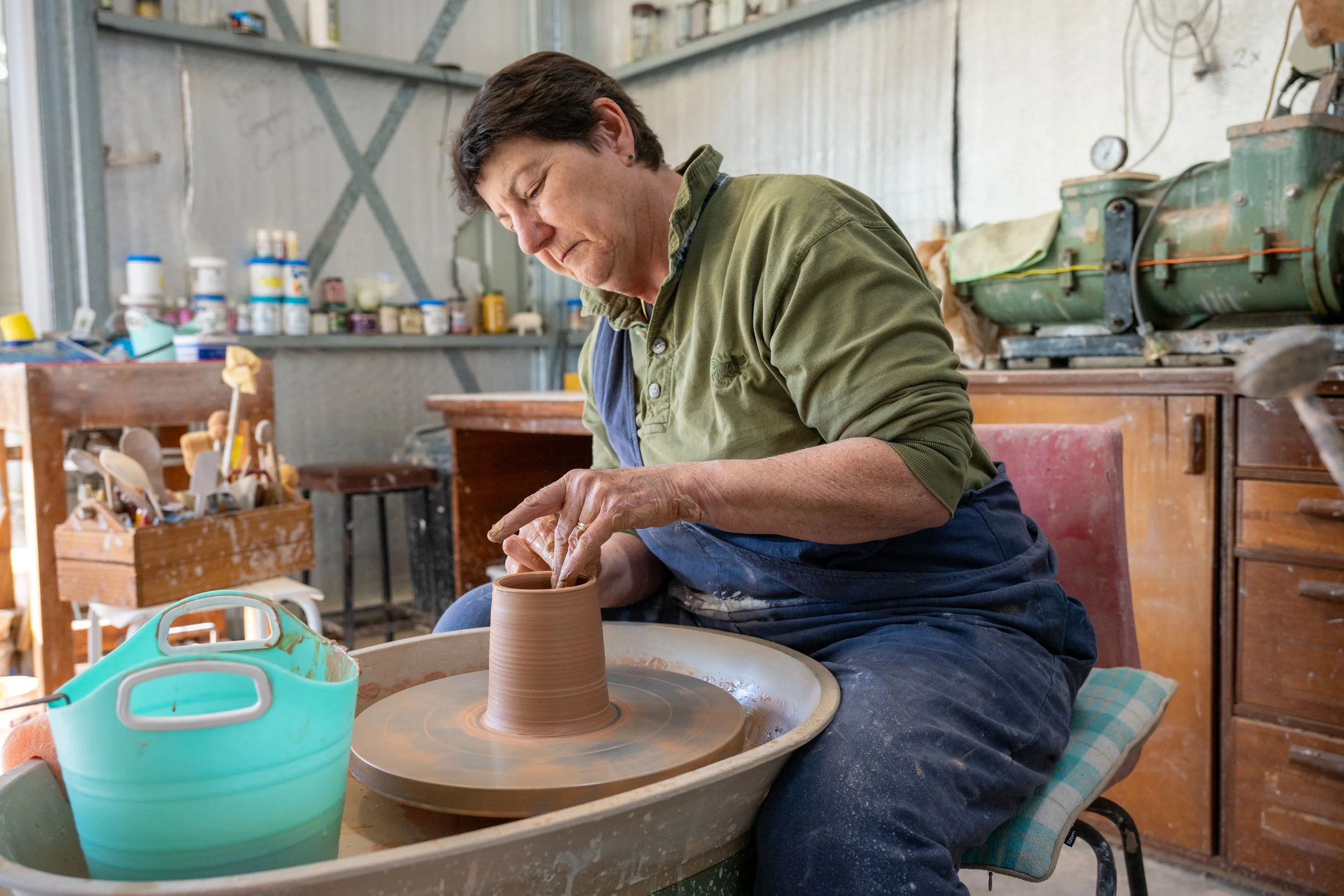
Photo Credit: Ginette Guidolin Courtesy Western Riverina Arts 2026
Looking at the pieces in the drying shed, there is a real connection with the earth, the history and artistry of making useable things with your hands.
For the novice potter, Sue offers age-old advice – practice, practice, practice. “See, a lot of people come along expecting to make a dinner set in their first lesson. So, keep expectations real.”
While handmade pottery had hit a slump with the mass production of crockery imports, there is more interest in handmade things and sales of ceramics is picking up again. Everything is cyclical, just like the weather. Sue will be packing up her wares to show for the Spring Festival in Griffith and the warmer weather means more time in the shed, as winter is too cold and the peak of summer too hot.
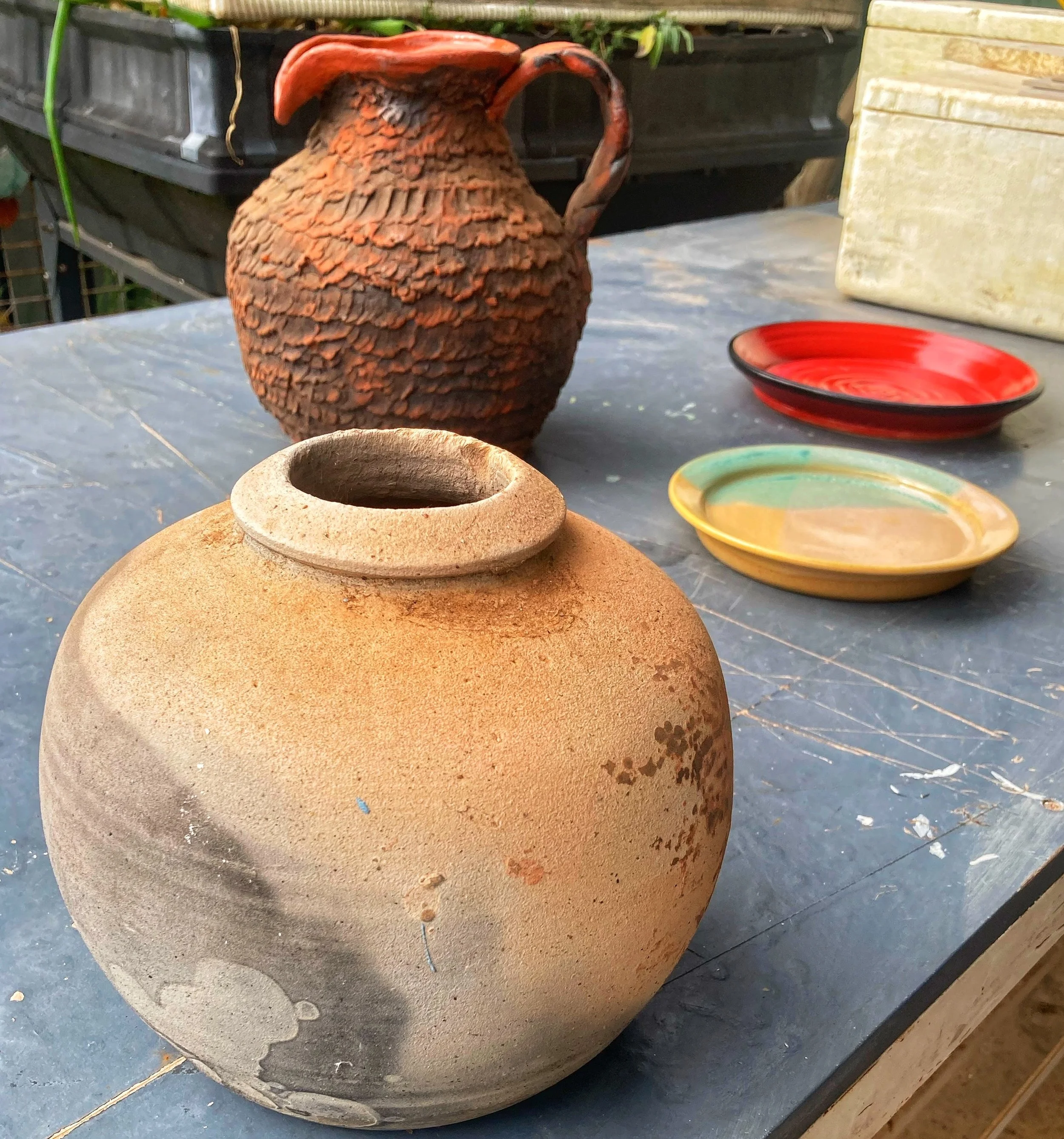
Photo Credit: Mel Ifield Courtesy Western Riverina Arts 2026
The future of potting is bright, but Sue is content to let others lead the charge. Once her current kiln goes, she has decided to stop and fully retire.
To retire in the town where clay first captured her imagination is truly the circle of life.
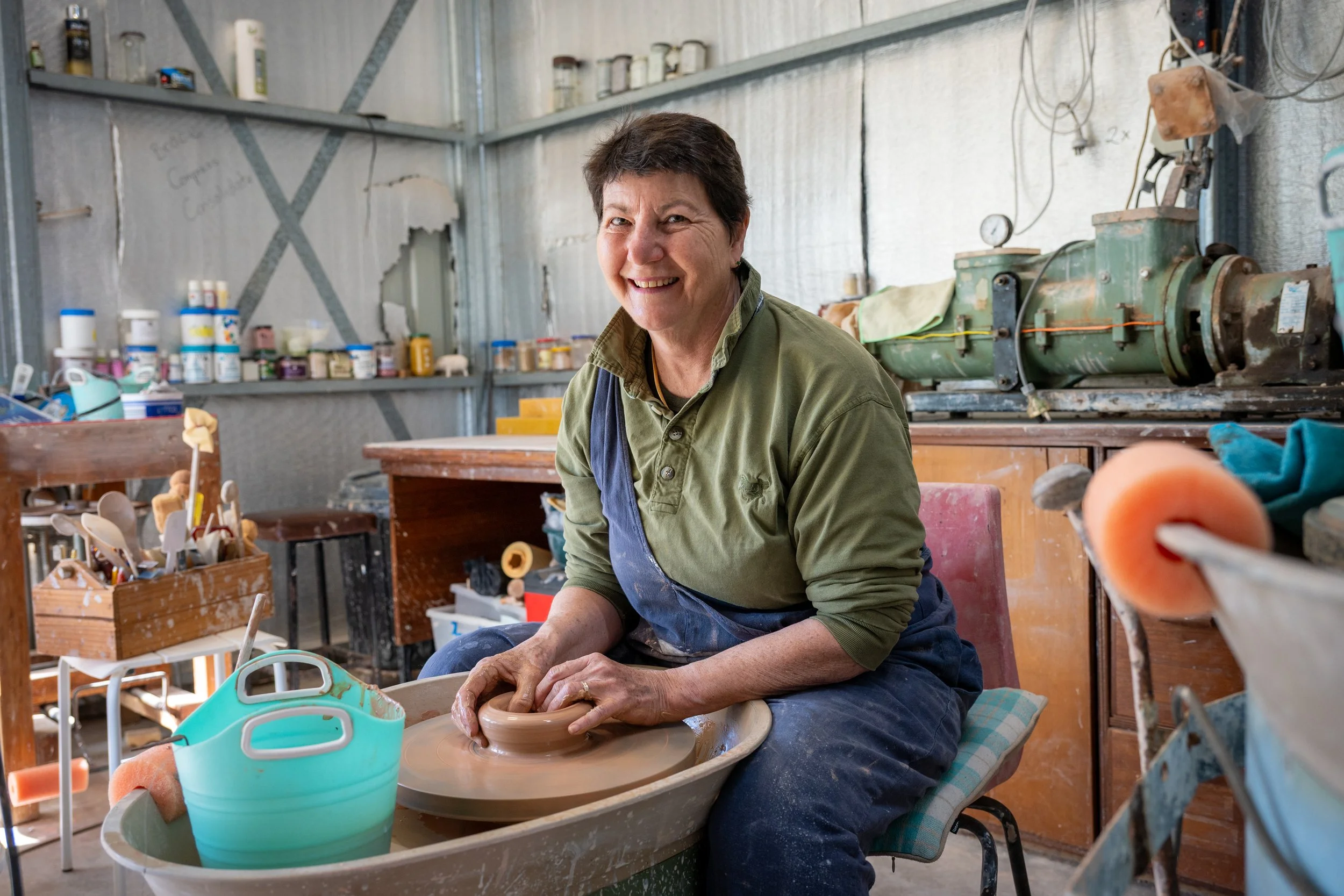
Photo Credit: Ginette Guidolin Courtesy Western Riverina Arts 2026
Article by Mel Ifield, 12.08.26, Commissioned by Western Riverina Arts.
AI Declaration: No AI was used in the writing of this article.