Spotlight Series October 2026: Dorothy Roddy - Stories, Memories and Paint
“There’s always a memory when you’re working on something,” says Dorothy Roddy. “So every painting I’ve done has a story.”
Increasingly, those stories are being shared by the people who look at her paintings.
A large canvas depicting the view from Scenic Hill hangs in a local financial services office, where it has become a conversation starter. Visitors initially ask, “Is that a photograph?” before wondering where the scene was painted from. For people from Griffith, the questions become more specific. Which landmark is visible? Which shed belongs to whom? Where might the viewpoint have been?
There is a moment of uncertainty, when a painting initially resembles a photograph. It is central to Roddy’s work as photography provides her with a starting point, but painting allows her to transform a captured fraction of a second into something slower, more deliberate and connected to memory.
The lifelong Murrami resident often works from her own photographs, while also interpreting historical images. Her paintings of the Riverina include contemporary landscapes as well as scenes from the mid-20th century, translating documentary photographs into vivid oil paintings.
“I have an intense curiosity,” she says. “What I do is, when I work on something I will identify an area I can improve on and do lots of research.”
That research can involve everything from historical conditions to the colours of machinery. When painting from an old black-and-white photograph, for example, Roddy has to reconstruct colours that are no longer visible.
Her painting Sunshine Harvesting, now in the permanent collection at the Leeton Museum and Art Gallery, shows her father and grandfather collecting rice from a Murrami paddock in the soggy conditions of 1956. The original photograph was smaller than a postcard, yet Roddy turned its grey tones into a detailed colour painting.

Sunshine Harvesting - Dorothy Roddy
The distinctive International tractor had to be researched to establish what its colours would have looked like when new. Roddy then had to develop the palette and blending techniques required to make those colours work within a scene originally recorded only in shades of grey.
“When I’m working with colour, there’s an app called Procreate — which is a cut-down version of Photoshop. You can do a colour check with it, by making a swatch based on what is in your photograph to compare and contrast to other areas.”
She used the technique while painting the Scenic Hill scene, matching the values and colours of the photograph. Her training in colour mixing also proved useful.
“Jeff Wright was so good at teaching colour mixing that I’ve never had difficulty.”
Photography remains important even when the resulting painting is not intended to look photographic. Roddy describes herself as a “realistic impressionist — or impressionistic realist”.
“It is where you set out to make the finished scene look real, but you haven’t used very precise techniques. You can use a variety of dark colours in the shade, rather than black, which gives a more interesting effect.”
Working from photographs has taught her to look closely at tonal relationships. This is particularly important when translating black-and-white photographs into colour.
“You actually have to desaturate photos to make them look believable,” she says. “Recently learning the technique to desaturate colours, by adding a small amount of colour from the opposite side of the colour wheel has been another progression in her skills.”
Her understanding of colour also extends to atmosphere and distance.
“Colour recession is a technique often employed, where yellow and the warm colours disappear first, leaving muted violets and blues in the distance. This allows the eye to progress into the painting from front to back. Our minds tell us as if we may be looking at green trees but we accept that in the distance they will be blue.”
The process is therefore more than simply copying an image. A photograph records what was in front of the camera, while Roddy makes decisions about what the viewer should notice and how the scene should feel.
That distinction is particularly evident in her current series of postcard-sized paintings based on a French holiday with her granddaughter.
“I found myself asking, ‘Could I paint that?’” she says. “I look at things and can now remember places.”
She took Elsie to Monet's garden. Later, when Elsie sees Monet's paintings, she will have her own memory of being there.
Another painting, of Elsie sitting in a window, has become a sentimental favourite. They were in France when they heard of the Pope's death, giving the painting an unexpected timestamp in their shared memory.

Elsie - Dorothy Roddy
In Paris photography helped her avoid the obvious postcard image.
“The Eiffel Tower was all about seeing it differently, so I didn’t want a cliché. I knew there was a garden at the bottom, so we walked around there and I took lots of pictures.”
The photographs became a way of exploring the place before choosing the composition. The resulting painting is therefore not simply a reproduction of a photograph but a memory distilled through several stages of looking.
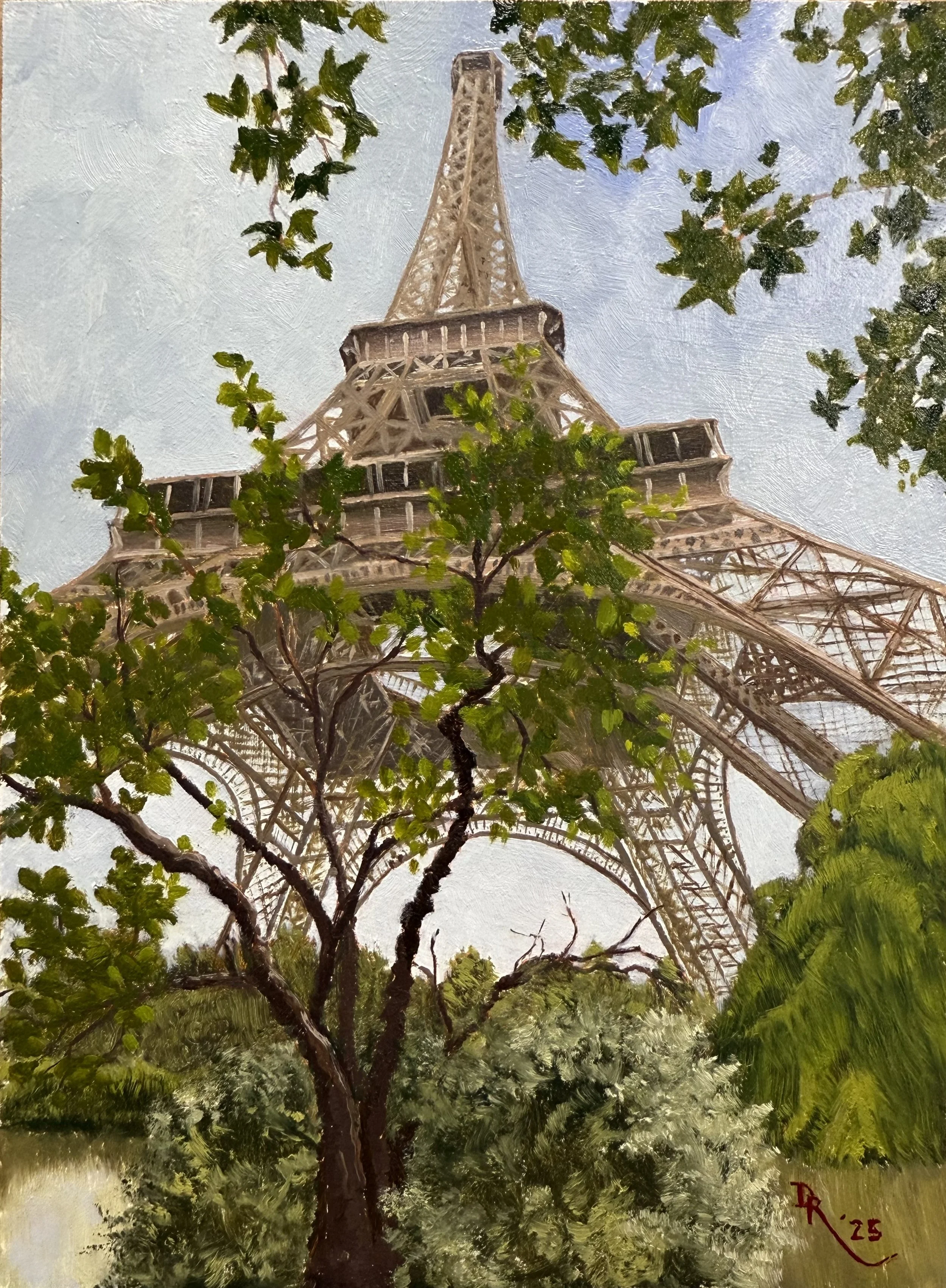
Eiffel Tower - Dorothy Roddy
The same process operates in her historical paintings.
Roddy’s collaboration with Leonie Napier produced the Yanco Moments in Time series in 2021, drawing attention to the history of the Yanco Agricultural Institute. The paintings acknowledge periods when the site was known as the Riverina Welfare Farm for Boys (1928–1942) and Prisoner of War Camp 15 Yanco (1942–1946).
Here photography becomes documentary evidence, but painting changes the way that evidence is encountered. Historical photographs can appear distant, particularly when reproduced as small, scratched or faded images. Roddy’s paintings give them a different physical presence.
The challenge is not simply to reproduce the photograph accurately. It is to make the viewer consider what it might have been like to stand within the scene.
As she explains, people bring their own experiences to a painting. A scene can invite recognition, curiosity or memories that were never part of the artist’s original intention.
“It doesn’t matter what you intend the painting to be, because everyone will have their own experience,” she says.
That is perhaps the most interesting relationship between Roddy’s paintings and photography. The camera captures a moment, but the painting opens it up again.
For Roddy, the process can begin with a photograph and continue through research, colour testing, historical investigation and hours of slow-drying oil paint. The final work may look like a simple window into a particular time and place, but behind that apparent simplicity is a methodical process of reconstruction.
Her progression as an artist has followed a similarly deliberate path. She began sketching in 2013 and started painting in oils in 2015, developing her skills through workshops, drawing groups and the influence of artists. John Wilson, in particular, became a mentor.
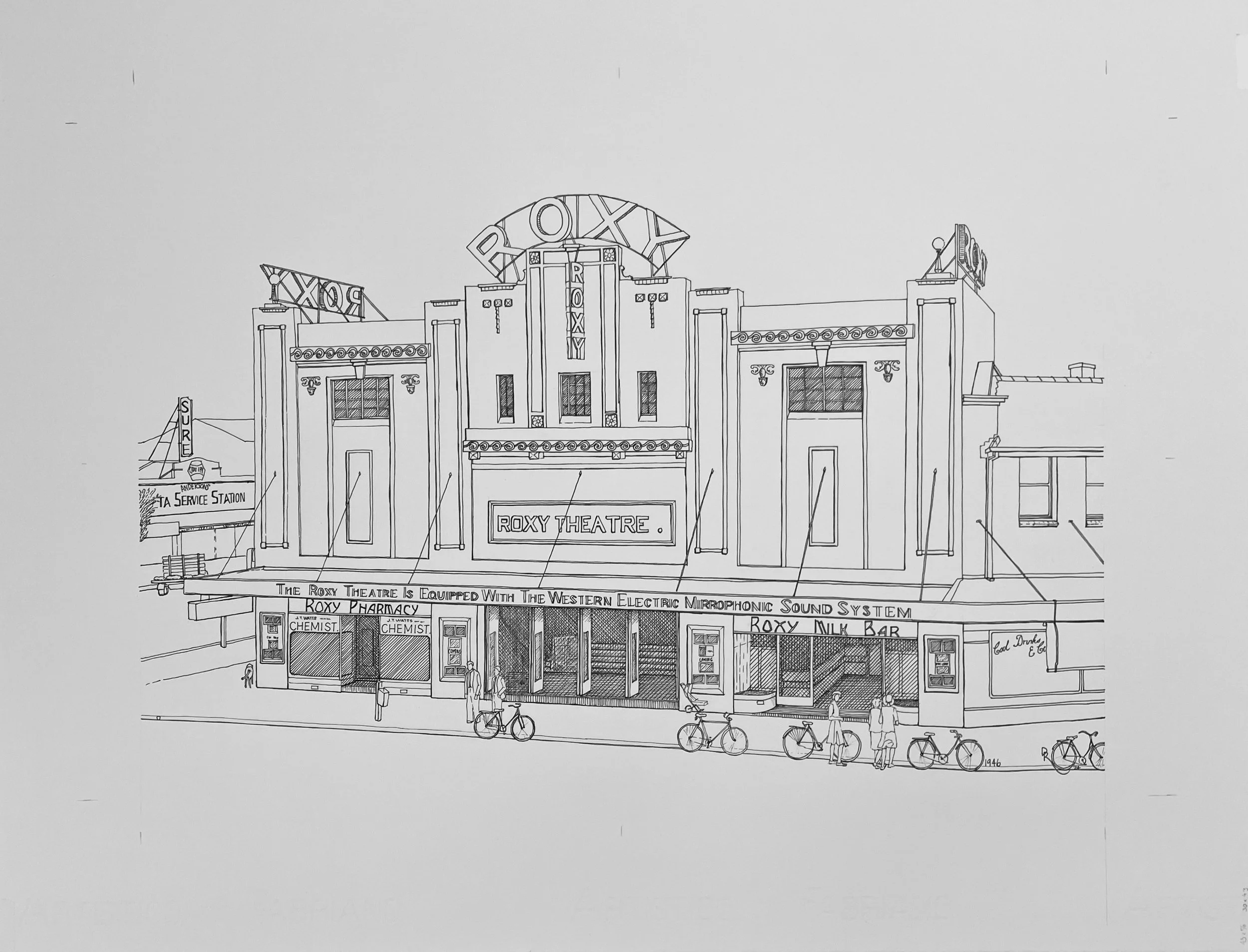
Drawing - Roxy Theatre ‘1942’- Dorothy Roddy
“He shared everything he knew,” she recalls, describing workshops that ranged far beyond painting. They talked about agriculture and politics and all sorts of things.
She later invited him to Leeton, where he offered advice on workshops, plein-air painting and the development of her own skills.
The lessons were sometimes technical, but they were also about learning how to see.
Wilson could look at a tree and paint it almost perfectly. For her, the process is more analytical.
“You have to keep all these things in the back of your head.”
She has accumulated an extensive mental library of such observations.
Her earlier career as a dressmaker also seems relevant. The coordination of hands, materials and precise techniques required to reproduce a pattern found another outlet in painting.
“I believe drawing in all its forms is an important underlying skill in my art and worthy of regular practice,” she says.
Attending life drawing sessions and mastering urban sketching have been ways of achieving this. “It is also a skill I like to pass on to others when the opportunity arises.”
That process of absorbing influences without simply imitating them is central to her philosophy.
“It's very personal,” she says. “You should be doing what comes naturally and apply your own style.”
Regional life, she says, offers an unusual opportunity for that kind of exploration.
“Living in regional NSW gives one the opportunity to go down a rabbit hole without interruption.”
Yet Roddy’s work is ultimately less about photographic accuracy than about translating one medium into another.
In an age when digital tools and artificial intelligence can generate photorealistic images almost instantly, her work draws attention to the human decisions hidden behind a convincing image: what to photograph, what colours to choose, and how to make a scene feel believable.
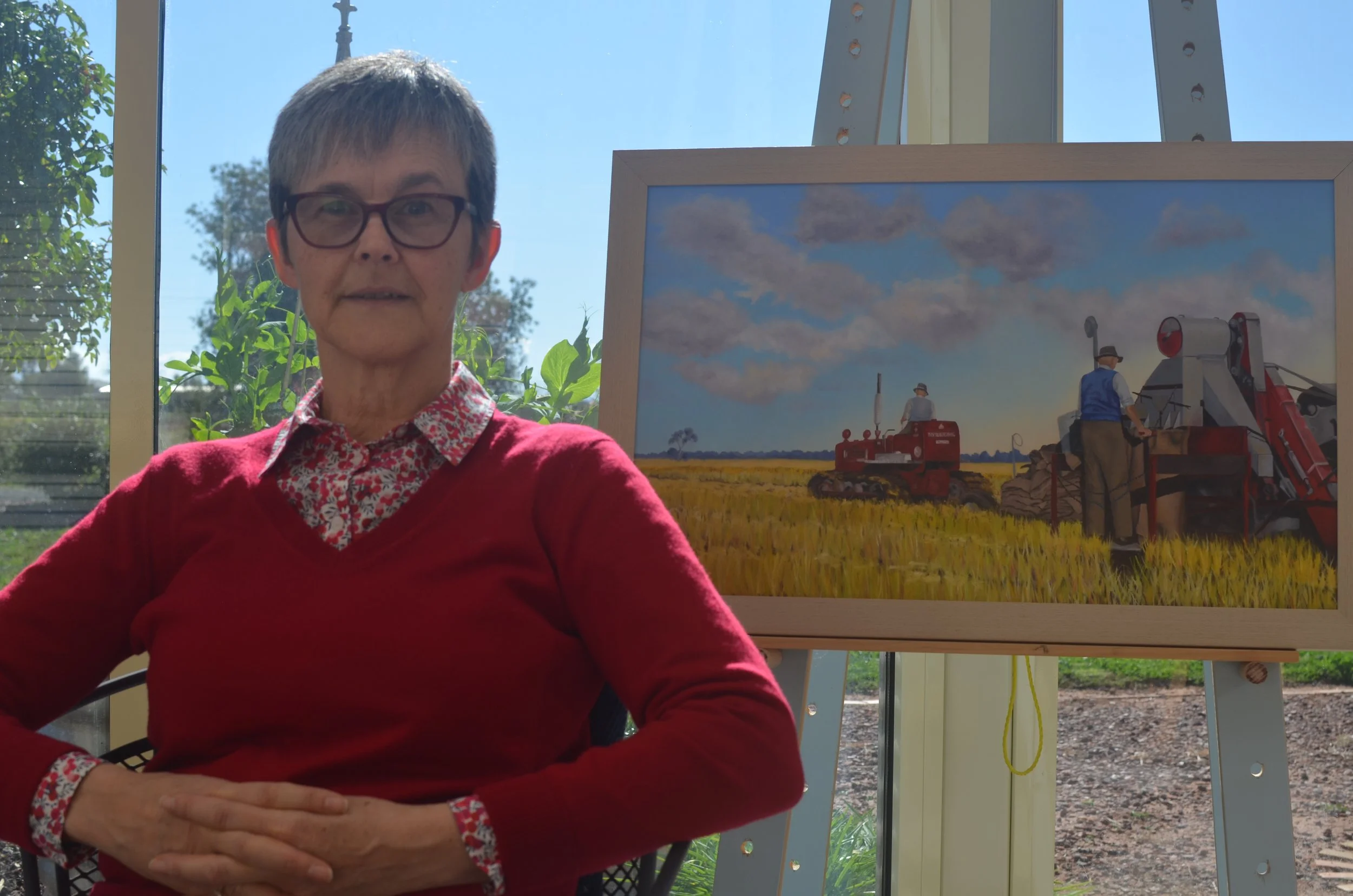
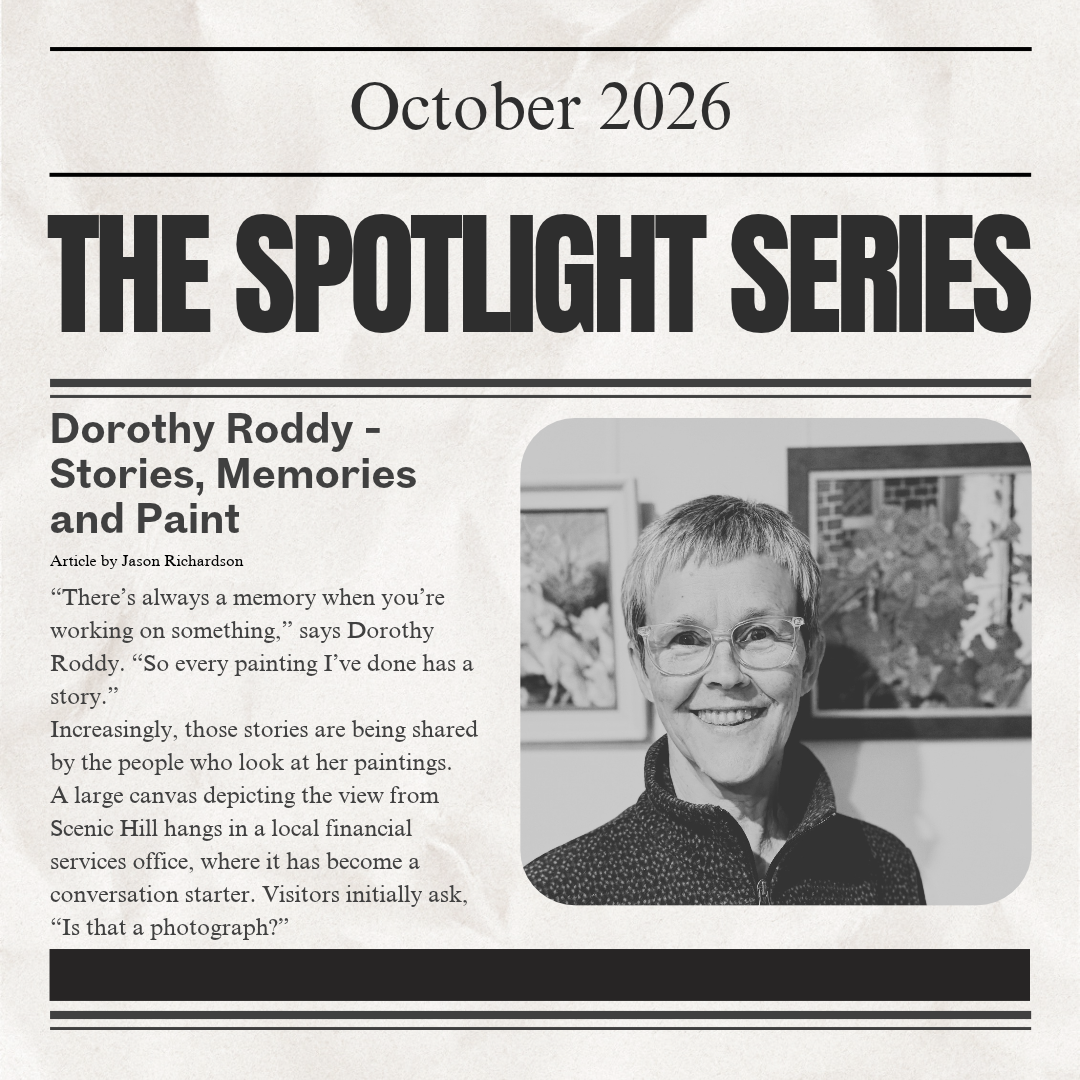
Dorothy Roddy - photo by Jason Richardson
Her paintings both extend the process of observation and slow it down.
It is clear Dorothy Roddy is making her own memories with art.
Article by Jason Richardson, 07.10.26, Commissioned by Western Riverina Arts.
AI Declaration: No AI was used in the writing of this article.